Suicide Prevention Month: “It’s Okay Not To Be Okay”
It’s okay not to be okay. A simple phrase that is so deeply validating and unassumingly compassionate.
For the people who often feel alone, sitting with the discomfort of their own dark thoughts, how comforting would that simple phrase be in the presence of a genuine human connection? To be seen rather than avoided, because society has conditioned us to believe that talk of suicide is taboo.
For the people who love and care for individuals battling with suicidal ideation, you may be feeling a complicated mix of guilt, rejection, fear, and frustration. If only I could take away their pain… Or did I do something wrong? (The answer is this: Their struggles are not a reflection of your relationship.)
How many of us have wanted to support someone going through a tough time, but didn’t know where to start? Or wanted to start a conversation but couldn’t picture how to do it without the awkwardness?
Setting aside the pressure of losing a life, ponder for a few moments on this: at your darkest moments, what would you imagine you'd like to hear? I imagine someone would say, “Hey, it is okay not to be okay. You’re not alone, and you mean so much to me. We’ll figure it out.”
What Are The Causes of Suicide?
Suicidal thoughts are caused by several factors that, when combined, can become intensely overwhelming – also known as a mental health crisis. It is deep emotional pain, mental health conditions, and personal struggles beyond one single relationship, culminating in a single cry for help.
Despite efforts to predict suicide using available research and data, it is quite a complicated task. Suicide is not caused by one factor alone, but by the intersection of several factors. It is dynamic and time-varied – not a linear cause-and-effect.
Anyone can be at risk of having suicidal ideation:
An older man who lost his wife of 60 years.
A young adult who experienced childhood abuse and has struggled with depression.
A middle-aged person experiencing homelessness after losing their job and housing.
A teenager experiencing racism and social isolation at school.
A parent struggling with chronic illness and a previous suicide attempt.
What Are The Warning Signs?
With suicide, oftentimes there are warning signs. There may have been a significant or life-changing event, or prolonged periods of stress. To help people experiencing suicidal ideation, we have to be familiar with the warning signs that typically occur before a suicide attempt:
A preoccupation with death, dying, or suicide through conversations, writing, or joking.
Statements such as “No one would miss me if I were gone”
Declining performance at school or at work
Loss of pleasure/interest in hobbies and activities
Withdrawing from social relationships, with partner, friends, and family
Sleeping too much or too little
Changes in mood
A person contemplating suicide may also feel a range of emotions, like depression, helplessness, confusion, or worthlessness
How To Talk To Someone About Suicide
Starting the conversation can feel awkward if we aren't prepared to do it. You might feel pressure to do the right thing so you don't cause further harm.
What we know now is that for some people experiencing suicidal thoughts, they sometimes internalize suicide as a weakness, an offense, or even a crime. These thoughts then become internalized feelings of shame, guilt, distress, and a lack of belonging.
If there is one takeaway I’d like you to get from this blog post, it is that we’re all human. You don’t have to perform and do something out of the ordinary. The best key is sincerity.
Here are some conversation starters:
Invite your friend to play a game of your favorite sport.
Start a casual conversation, checking in with your friend while playing an online game together.
Take them out for a meal after school or after work.
Send a quick text with a simple “What’s up?”
Invite them over to share a hobby while checking in.
Take a walk around the park or go on a drive
If you notice any of the warning signs as stated above or you suspect there may be suicidal ideation, don’t be afraid to start a conversation. The sooner we recognize the signs, the sooner we can intervene and help them get the support they need.
Start the conversation by sharing signs you’ve observed, like “I’ve noticed you’ve been sleeping in lately, drinking more, and have been posting more sad songs online. I am worried about you.”
Ask directly about suicide-related thought and plans. You could say: “Are you thinking about suicide?” “When was the last time you thought about suicide” or “Do you have a plan? How would you do it?”
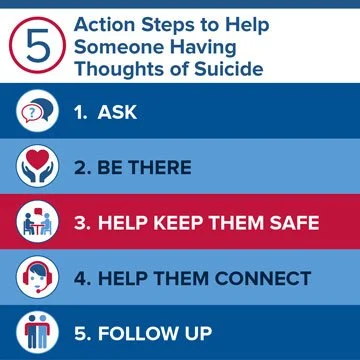
If they answered “yes” to any of the previous questions, seek help immediately.
What Else Can You Do?
Call a healthcare professional, or a therapist, psychiatrist, or physician who has been working with the individual.
Removing the method (e.g., medications, weapons) will help reduce risk.
Call 988 to reach crisis counselors at the 988 Suicide & Crisis Lifeline.
If it is an immediate or life-threatening emergency, call 911.
What not to do:
Don’t promise secrecy.
Don’t handle it alone - ask for help!
Don’t invalidate by saying, “We all go through tough times.” or “Snap out of it.”
It Is Okay Not to Be Okay
Starting conversations about suicide can reduce suicidal ideation by providing a different perspective on the current situation, reducing social stigma, and increasing the likelihood someone will seek treatment.
Many people who have mental illnesses are not affected by suicidal thoughts, and not all those who attempt or die by suicide have mental illnesses. Most suicidal thoughts and attempts are triggered by significant losses, relationship problems, and life stressors that lead to mental health crises. In this state, one cannot effectively cope with the resources they have.
In other words, suicide is an effort to escape deep psychological pain or a mental health crisis.
Let’s work to destigmatize suicide and reach out to those we care about. It all starts with a conversation.
“It is okay not to be okay, but I am worried about you. You are not alone, and you mean a lot to me. Let’s get the help you need, and I will be here to support you.”